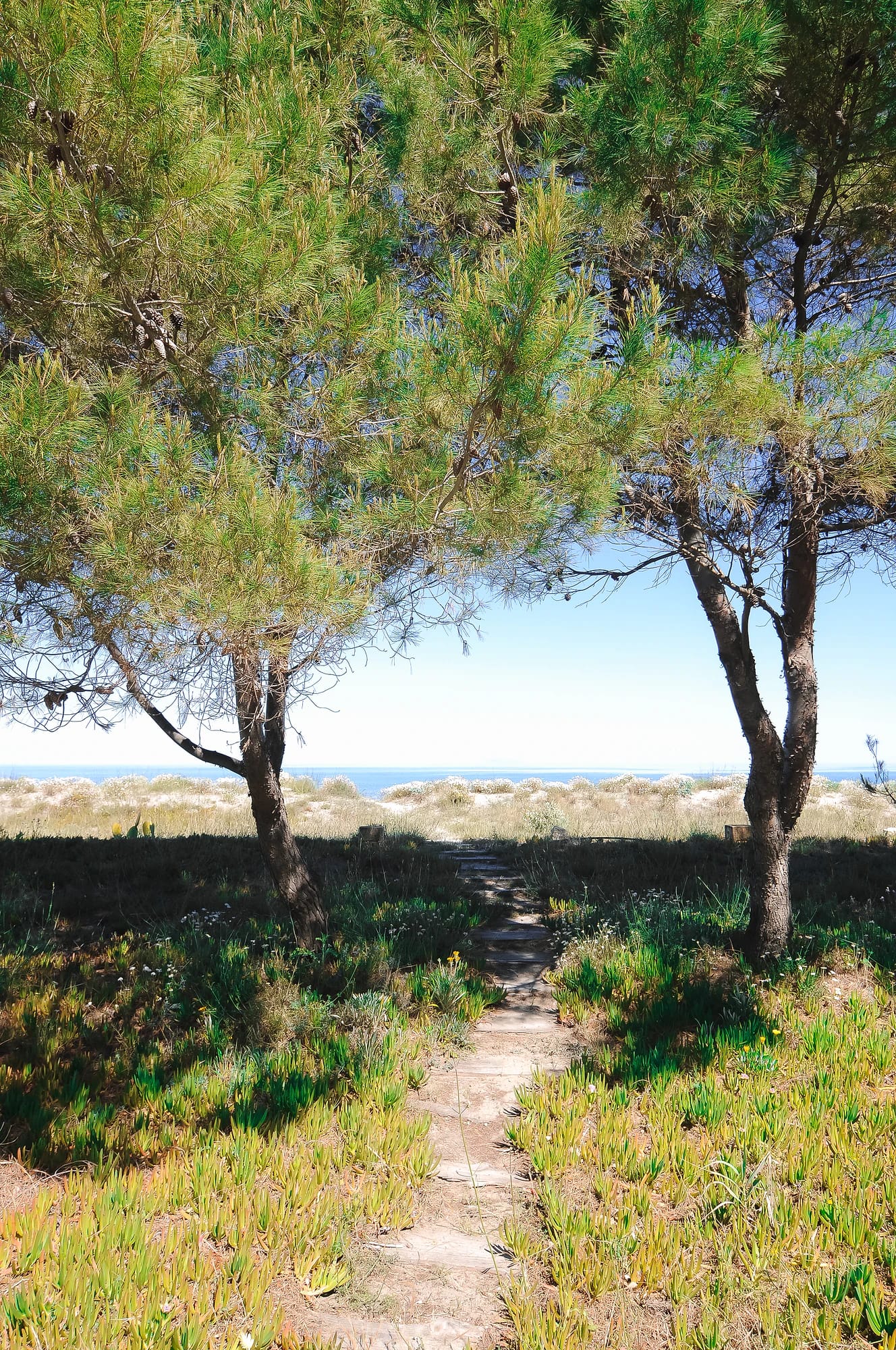
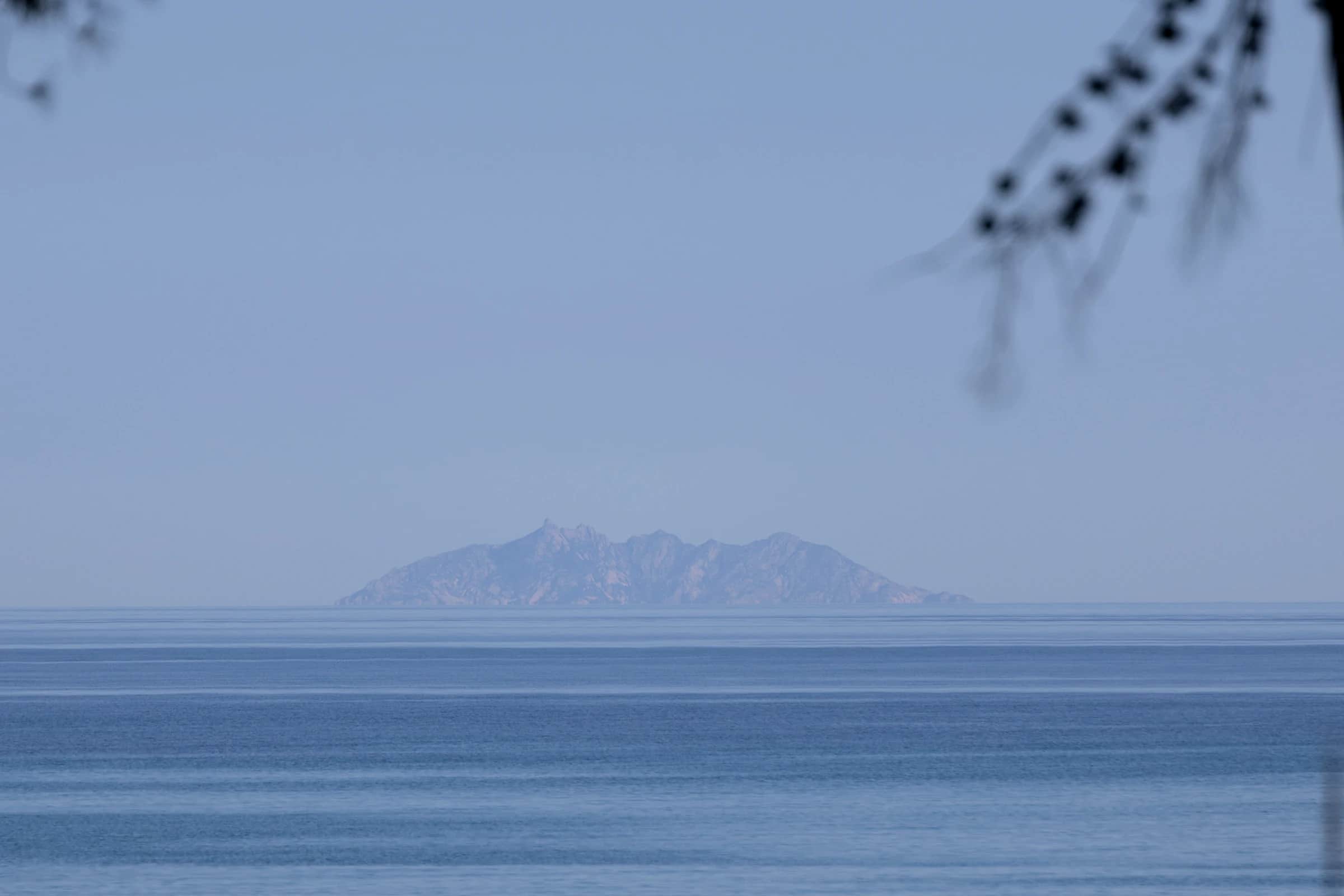
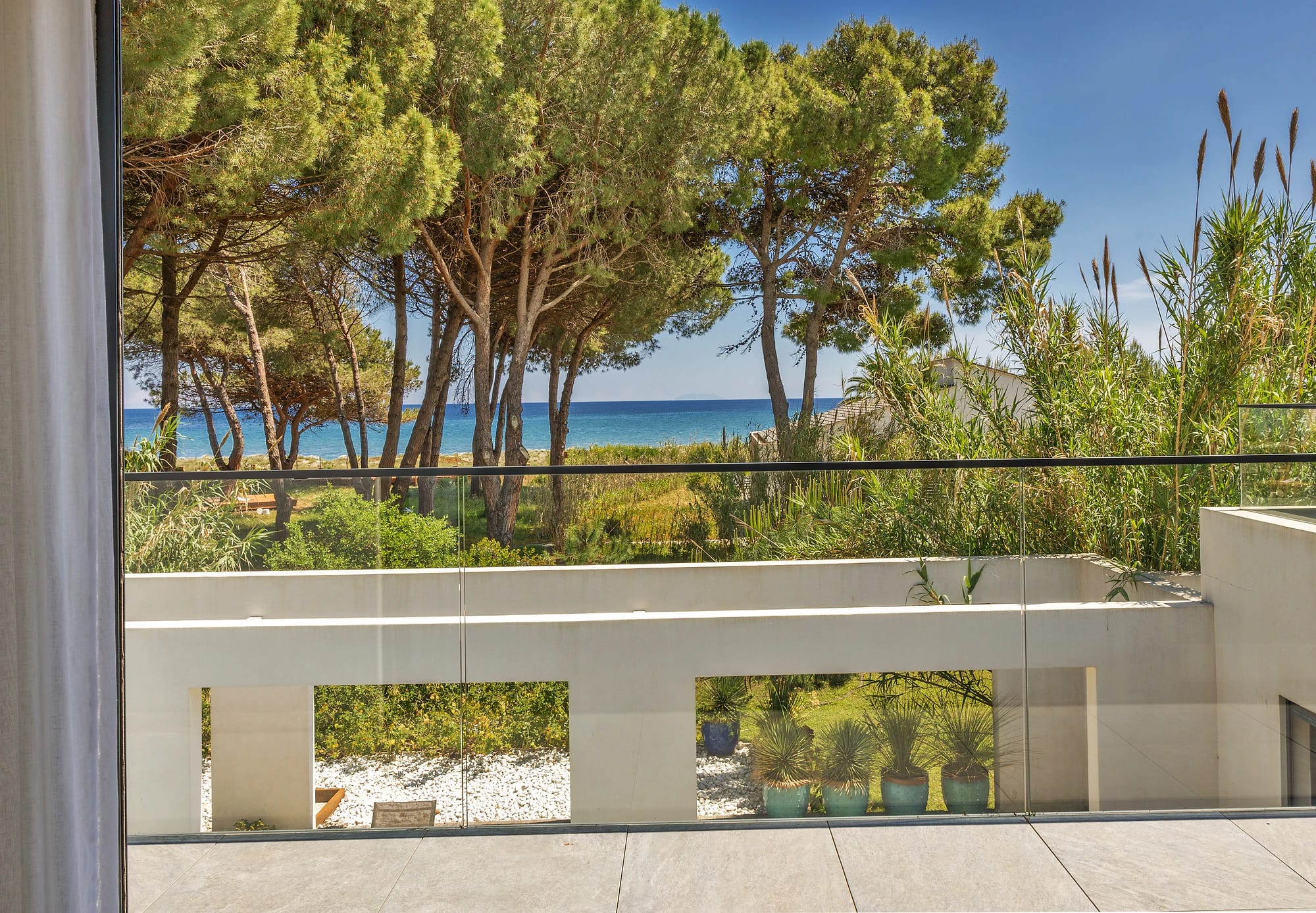
On Corsica’s east coast, the sun rises out of the sea. On a clear morning, an almost pyramid-shaped outline settles on the horizon, a little south of due east: that is Montecristo. Further north, on days of very good visibility, the island of Elba shows as well. Our guests watch it from the beach, from the terrace of La Vignarella or from the upper floor of U Magazinu.
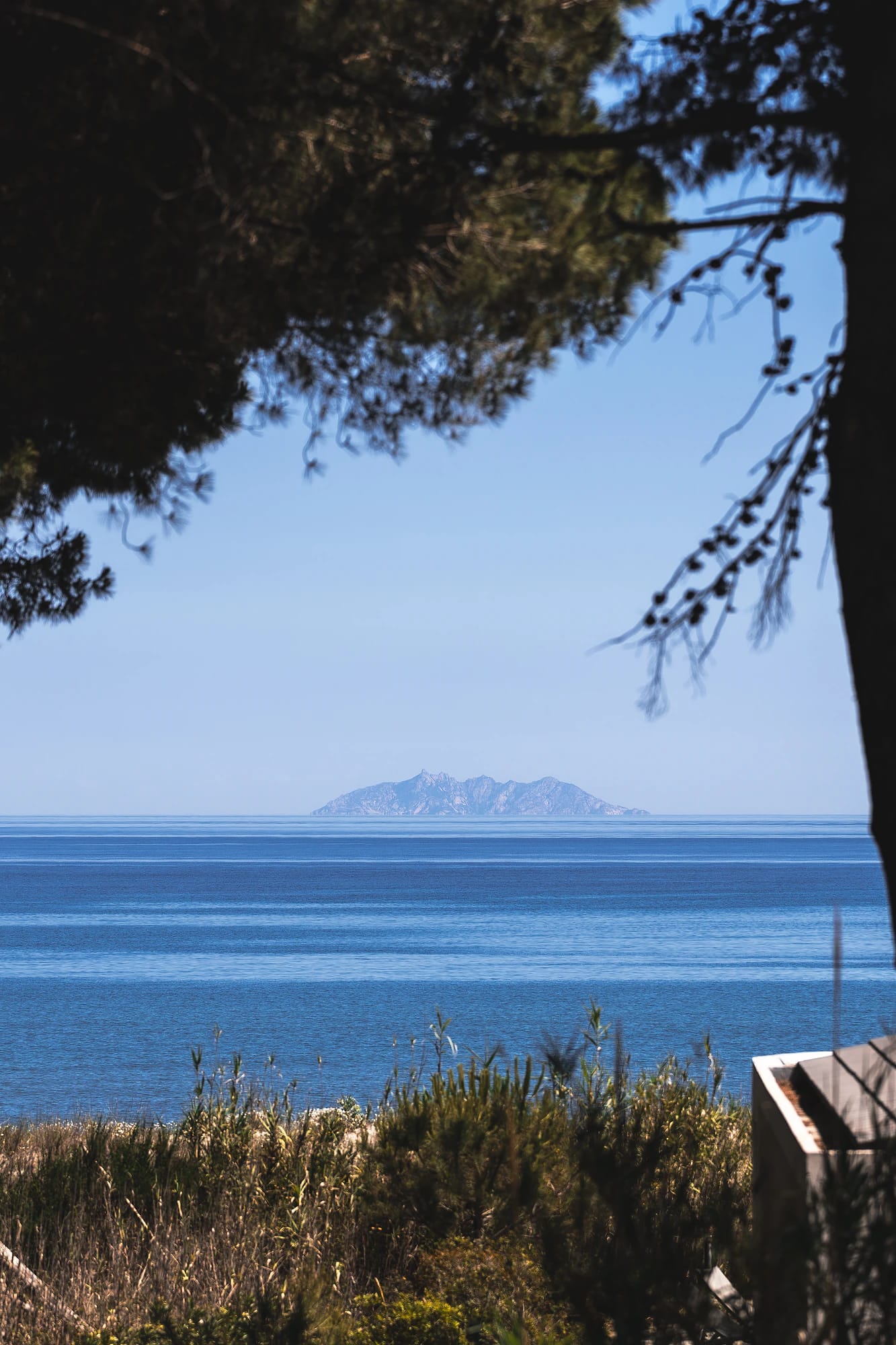
Where is Montecristo?
Montecristo belongs to the Tuscan Archipelago, in the Tyrrhenian Sea, and comes under the municipality of Portoferraio on Elba. The Tuscan Archipelago National Park describes it as a rocky massif of about 10 km², ringed by 16 km of sheer cliffs and broad slabs of granite that drop steeply into the sea. It is the island of the archipelago furthest from the Italian mainland, 63 km offshore. A ridge runs along it with three main summits: Monte della Fortezza (645 m), Cima del Colle Fondo (621 m) and Cima dei Lecci (563 m).
We worked out the distance between the estate and the summit of Monte della Fortezza at roughly 64 km as the crow flies.
Why you can see it from the east coast
The Costa Verde faces east, across the Tyrrhenian Sea. The sun rises over the water and, depending on the season, closer to or further from the island’s outline: at first light Montecristo appears as a dark shape against a brightening sky. At 645 metres it stands well clear of the horizon, even at this distance. On hazy, hot days it fades from view.
One guest, C. H., wrote in our guestbook in May 2019: “To wake up and see the sunrise over monté Cristo is magic.”
A strict nature reserve
Montecristo has been a state nature reserve since a decree of 4 March 1971, and the Treccani encyclopaedia classes it as a strict nature reserve (riserva naturale integrale). In 1988 the Council of Europe awarded it the European Diploma of Protected Areas as a biogenetic reserve. The island and its surrounding waters lie in zone 1 of the Tuscan Archipelago National Park, under the watch of the Carabinieri biodiversity unit based in Follonica, Tuscany.
The park describes the island as uninhabited and without services of any kind. Swimming is forbidden, boats may not circle the island within about a kilometre of the shore, and plants, animals and rocks may not be removed.
Montecristo’s wildlife and plants
The island is made almost entirely of granite formed between seven and five million years ago. Its slopes carry coastal garrigue and low maquis of heather, rosemary and rock rose, with a few holm oaks gathered near Cima dei Lecci, literally the “peak of the holm oaks”. The park lists around 400 plant species, among them fragrant curry plant and cat thyme, and a small toadflax found only in the Tuscan Archipelago, Linaria capraria, which grows on the ruins of the monastery.
- The Montecristo goat, the most conspicuous animal: brought from Asia Minor in antiquity by Phoenician and later Greek seafarers, it has survived to the present day only on this island.
- Discreet reptiles and amphibians: the western whip snake, the viper, the European leaf-toed gecko and the rare painted frog.
- Seabirds, including the Yelkouan shearwater, whose colonies are of European importance, and the European shag; in the migration seasons, many birds stop here to rest and feed.
- Around the island, protected waters where whales and other cetaceans are often sighted.
From a hermit to The Count of Monte Cristo
According to the park, Jupiter may have been worshipped here in Roman times. In the fifth century Saint Mamilian took refuge on the island while fleeing the Vandals, and a thriving monastic community lived there until the sixteenth century. The nineteenth century brought attempts at farming, and later the Italian royal family came to hunt and fish, drawn by the island’s seclusion.
Saint Mamilian is no stranger on this coast. In the hills nearby, at San-Giovanni-di-Moriani, a chapel bears his name, San Mamilianu; according to the Corsican news site Corse Net Infos, it was among the properties placed under the authority of the abbey of Montecristo.
Yet it was Alexandre Dumas who made the island famous. The Count of Monte Cristo first appeared as a serial in the Journal des débats from 28 August 1844 to 15 January 1846, according to the catalogue of the Bibliothèque nationale de France. In the novel, Abbé Faria tells Edmond Dantès of a treasure hidden on the island; after his escape, Dantès goes there, finds it and becomes the Count of Monte Cristo. The island in the book belongs to fiction. The real one is best admired from a distance.
Watching Montecristo from the estate
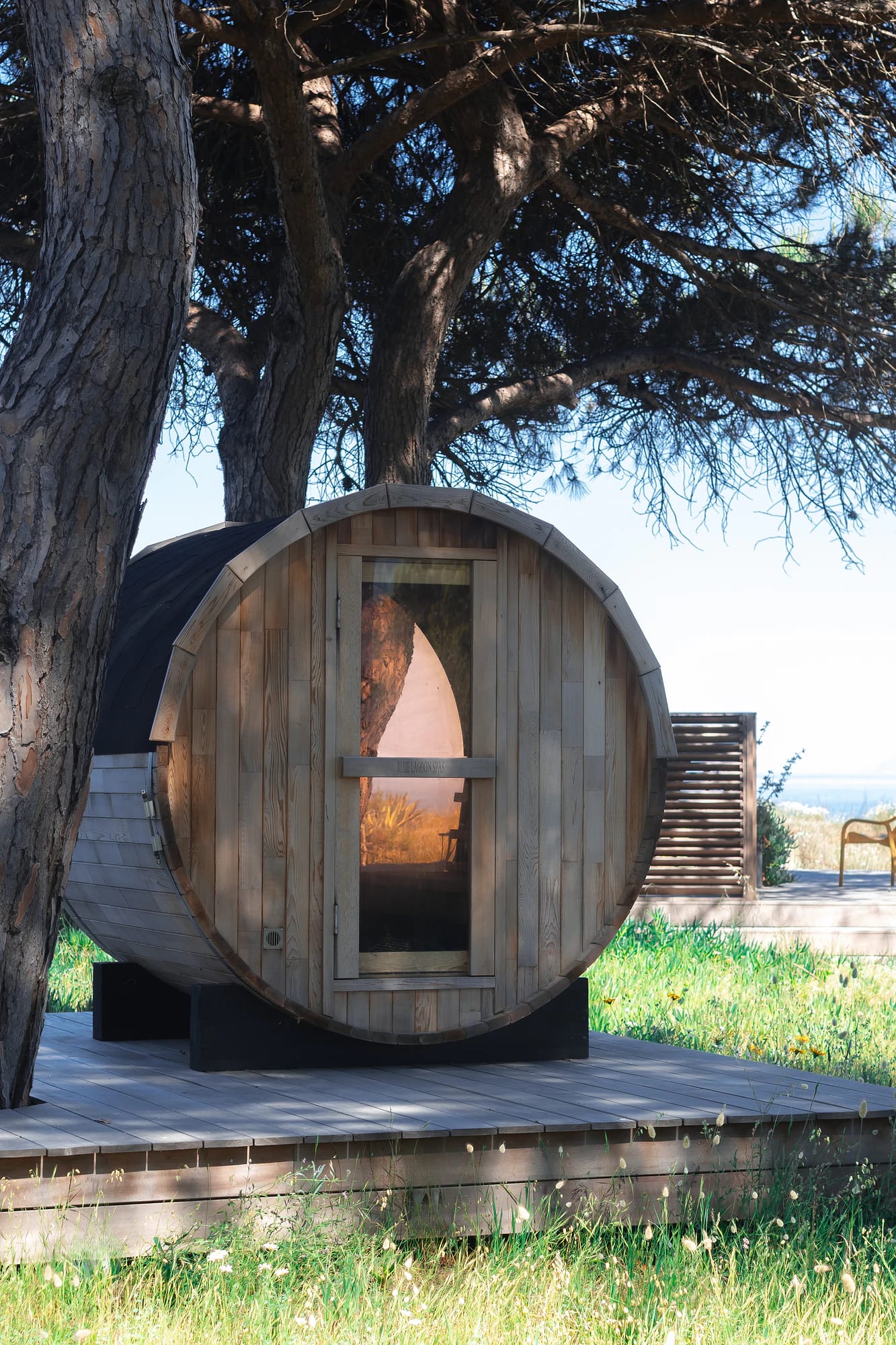
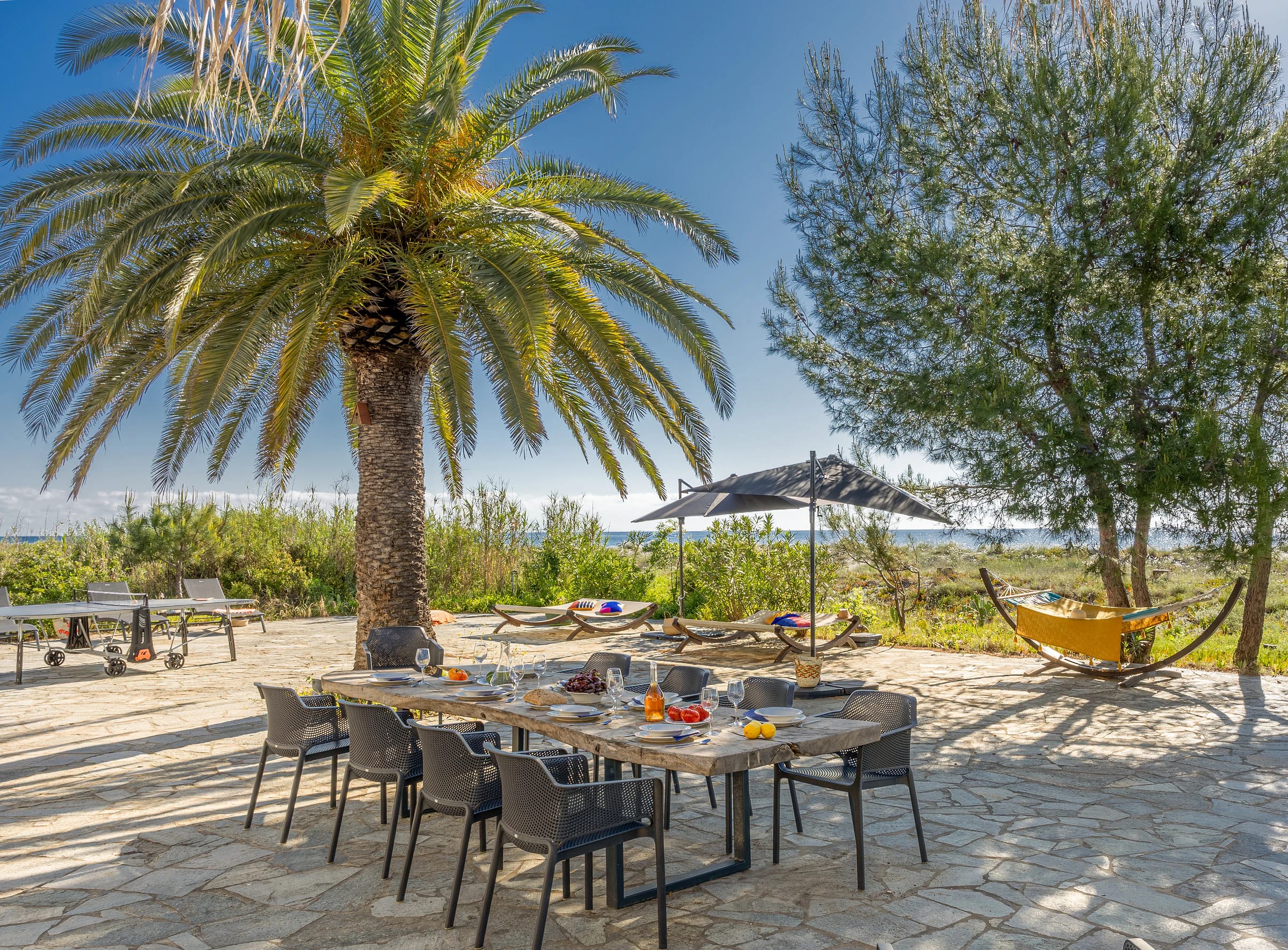
The finest way to enjoy Montecristo is to look at it. At La Vignarella, the house sits just behind the low dune: you slide open the wide glass doors in the morning and the sea fills the frame. At U Magazinu, coffee is taken on the upstairs solarium, facing the island. The estate’s sauna, at the edge of the dune, also looks out to sea: a session at first light, then a walk across the sand into the water, is a way of seeing the island just as the day begins.
For the beach itself, read our guide to beaches and swimming; for the coast around the estate, our guide to the Costa Verde. To choose the house you will watch it from, check availability and then send us your enquiry: we reply to you ourselves.
Frequently asked questions
Can you see Montecristo island from La Vignarella?
Yes, on clear days: Montecristo appears on the horizon on the side where the sun rises, and Elba can also be made out when visibility is good. You can see it from the beach, from La Vignarella’s terrace and from the upper floor of U Magazinu.
How far is Montecristo from the estate?
Roughly 64 km as the crow flies separate the estate from the island’s summit, Monte della Fortezza (645 m), according to our own calculation from rounded coordinates.
Can you visit Montecristo island?
Yes, but only on guided visits run by the Tuscan Archipelago National Park, booked in your own name and departing from Tuscany. Access is limited to 2,000 visitors a year and closed to children under 12; there is no regular boat service from Corsica.
Can you swim at Montecristo?
No. Swimming is forbidden at Montecristo, as is sailing around the island within about a kilometre of the shore.
Is this the island from The Count of Monte Cristo?
Yes. It is on this island that, in Alexandre Dumas’s novel serialised from 1844 to 1846, Edmond Dantès finds the treasure that turns him into the Count of Monte Cristo.
Sources
- Parco Nazionale Arcipelago Toscano, “Isola di Montecristo” (geography, nature, history) (opens in a new window)
- Parco Nazionale Arcipelago Toscano, “Come arrivare” (visits, quotas, departures) (opens in a new window)
- Parco Nazionale Arcipelago Toscano, Montecristo visits (how they are run) (opens in a new window)
- Parco Nazionale Arcipelago Toscano, “Le regole di fruizione” (status, restrictions, seasons) (opens in a new window)
- Treccani, Enciclopedia online, “Montecristo” (opens in a new window)
- Council of Europe, list of European Diploma sites (2023) (opens in a new window)
- Bibliothèque nationale de France, catalogue record “Le Comte de Monte-Cristo” (opens in a new window)
- Alexandre Dumas, Le Comte de Monte-Cristo, volume I (Project Gutenberg) (opens in a new window)
- Corse Net Infos, “I Santi: Santu Mamilianu” (opens in a new window)
- OpenStreetMap, summit of Monte della Fortezza (coordinates used for the distance) (opens in a new window)